Signed in as:
filler@godaddy.com
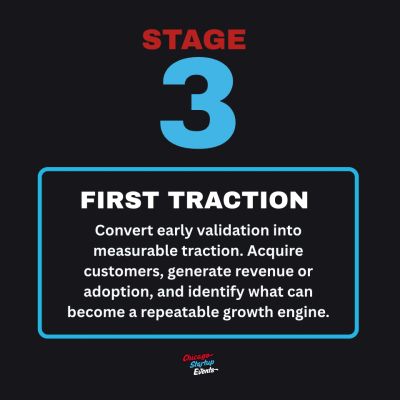
Stage 3 asks a central question:
“Can this work more than once without heroics?”
At this stage, the focus shifts from proving that someone will use or pay for the solution to understanding whether that traction can be repeated deliberately.
Founders are looking for evidence of consistent customer behavior, clearer acquisition patterns, stronger retention or repeat usage, and an operating approach that doesn't depend on extraordinary effort every time.
The goal is determining whether the business has something repeatable enough to build on.
Traction without repeatability is fragile.

Serves: Chicago-based founders with a working product pursuing early customers and repeatable GTM motion
Fit: Provides hands-on growth support, operator access, and execution-focused programming aimed at helping founders convert early interest into traction.

Serves: Under-resourced and underestimated founders building revenue-generating businesses in Chicago
Fit: Provides flexible capital, coaching, and financial readiness support to help founders stabilize early revenue and prepare for scale and external scrutiny.

Serves: Founders with a developed product and early market validation, especially in food, beverage, and consumer-focused innovation
Fit: Provides capital, operator expertise, and structured acceleration to help founders refine execution, strengthen unit economics, and scale validated food and beverage concepts.

Serves: Midwest-based founders with a live product who need to prove early customer adoption, usage, or revenue
Fit: The seed program emphasizes validating real traction signals and GTM motion before companies are considered ready for larger institutional scale.

Serves: Venture-backed and growth-oriented founders seeking peer support through scaling inflection points
Fit: Provides structured peer groups and operator insight that help founders navigate early GTM traction challenges and prepare for scale, capital, and leadership complexity.

Serves: HealthTech and life sciences founders with a developed solution and early validation seeking clinical, commercial, and ecosystem support
Fit: Provides workspace, programming, and industry access to help founders validate in real healthcare environments, refine solutions, and advance toward scalable partnerships and adoption.

Serves: Hardtech and applied-innovation founders moving from solution to real customers
Fit: Offers pilot programs and industry connections that help founders

Serves: B2B founders seeking pilots and enterprise customers
Fit: Connects founders directly with corporate partners to secure pilots, validate GTM motion, and establish early commercial traction.

A clear explanation of why measuring real user engagement—not vanity metrics—is critical for early-stage startups seeking product-market fit and sustainable growth.

A practical guide to measuring startup traction, outlining key KPIs investors expect and helping founders translate early activity into credible signals for fundraising and scale.

This is a curated 2025 post identifying early-stage funding ecosystem in Chicago, showcasing angels, accelerators, and various programs that are specifically designed to assist first-time founders as they navigate the initial stages of raising venture capital.

A practical article outlining how founders can define, measure, and communicate traction using the right metrics for their stage, helping teams move beyond vanity signals toward evidence that matters to investors and operators.
