Signed in as:
filler@godaddy.com
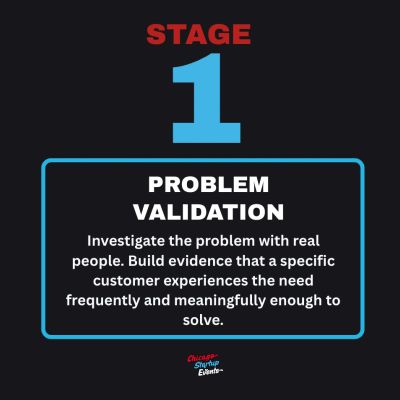
Stage 1 asks a central question:
“Is this problem real, urgent, and meaningful enough to justify building a solution?”
At this stage, the focus shifts from believing a problem exists to gathering evidence that the right people actually experience it and care enough about solving it.
Founders are testing assumptions about who has the problem, how they experience it, what they do today, and whether the problem creates enough friction, cost, or urgency to drive action.
The goal is to build enough evidence to determine whether the problem is worth solving.
Conviction can start the journey. Evidence determines whether to continue.

The Chicago Tech Scene Navigator serves as a dynamic guide aimed at assisting founders in navigating the vibrant landscape of Chicago. This resource simplifies the process for early-stage founders to connect with essential tools, networks, and opportunities throughout the city.

Serves: First-time and early-stage founders exploring problem spaces and customer needs
Fit: Entry-level programs and workshops help founders pressure-test assumptions and refine problem understanding prior to solution development.
Operating Stages Supported: Stage 0: Orientation, Stage 1: Problem Validation, Stage 2: Solution Shaping, Stage 3: First Traction, Stage 4: Readiness for Scale

Serves: Healthcare and digital health founders validating problems with providers, payers, and operators
Fit: Provides direct industry access and structured pathways to test whether healthcare problems are real, urgent, and worth solving before building.
Operating Stages Supported: Stage 0: Orientation, Stage 1: Problem Validation, Stage 2: Solution Shaping, Stage 3: First Traction, Stage 4: Readiness for Scale

Serves: Students, alumni, and aspiring founders evaluating entrepreneurial readiness
Fit: Offers ideation programs and perspective-building resources that help founders assess fit and readiness prior to execution.
Operating Stages Supported: Stage 1: Problem Validation, Stage 2: Solution Shaping, Stage 3: First Traction, Stage 4: Readiness for Scale

Serves: Founders (often technical or research-backed) testing whether a real buyer
Fit: Structured customer discovery program explicitly designed to validate problem hypotheses through direct buyer interviews before solution commitment.
Operating Stages Supported: Stage 1: Problem Validation, Stage 2: Solution Shaping

Serves: Early-stage and aspiring founders, particularly from underserved communities, working to clarify ideas, customers, and business fundamentals
Fit: Sunshine Enterprises provides structured education, coaching, and community support to help founders validate problems, define customers, and build foundational business clarity before scaling.
Operating Stages Supported: Stage 1: Problem Validation, Stage 2: Solution Shaping, Stage 3: First Traction

Serves: Student, alumni, and first-time founders exploring early startup ideas
Fit: The pre-accelerator is designed to help founders validate real problems and translate early insights into initial solution concepts before committing to full execution.
Operating Stages Supported: Stage 0: Orientation, Stage 1: Problem Validation, Stage 2: Solution Shaping, Stage 3: First Traction

Serves: Women founders and entrepreneurs building early-stage businesses
Why it fits: Provides market research, customer discovery guidance, and early business modeling support to validate problems and shape viable solutions before scaling.
Operating Stages Supported: Stage 0: Orientation, Stage 1: Problem Validation, Stage 2: Solution Shaping, Stage 3: First Traction, Stage 4: Readiness for Scale
Y Combinator Managing Director and Group Partner Michael Seibel on the biggest mistakes first-time founders make.
A reality check on why market size, timing, and ambition matter early—illustrating how even strong teams fail when the opportunity is structurally too small.

Practical guidance for early founders on how to run customer development conversations that surface real behavior, not polite feedback—so you can validate the problem before building or fundraising.
A clear explanation of why market size and timing determine startup outcomes, helping founders avoid building great products in opportunities that can’t support real growth.
Explore insights on building confidence in your startup idea, avoiding superficial validation, and staying focused on true progress and conviction as a founder.
